
Blog
Fireworks at Your Venue: What the Law Actually Requires
20 August 2026
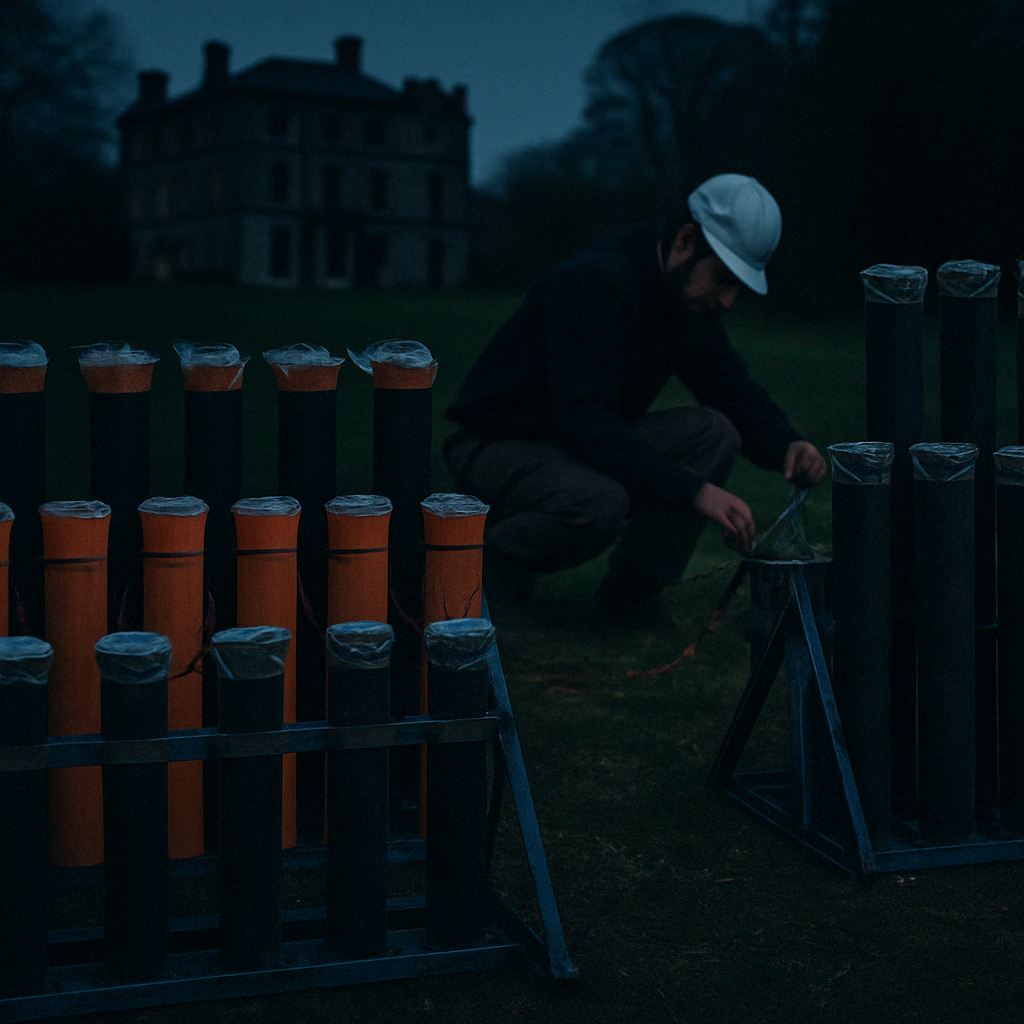
A guide for event venues, wedding coordinators and event organisers.
Since the Emergency Alert of 14 August, we have had the same question from venues almost daily: are firework displays still allowed?
The short answer is yes. Professional firework displays are lawful, and nothing that happened in August changed that. But the longer answer is more useful, because there is a real legal duty on venues here, and it is not the one most people assume. Understanding it puts you in a far stronger position than a blanket ban ever will.
This is a plain English guide, not legal advice. If you want certainty on your own circumstances, take it from a solicitor or your fire safety adviser.
What the Emergency Alert actually said, and who it was for
At 19:01 on Friday 14 August, an Emergency Alert was sent to every mobile phone in England and Wales. It read:
There is a very high risk of wildfires nationally. Residents, landowners and visitors should not undertake any activity that could start a fire, including disposable barbecues, firepits, garden incinerators or fireworks. Even a small flame can rapidly develop into a major wildfire placing lives, homes, businesses and emergency responders at risk. Follow official updates and report signs of fire immediately by calling 999.
Three things are worth noticing.
It was advisory. It was a public safety message, not an instrument of law. The only legal change made by the Government at that time was a temporary restriction on the sale of disposable barbecues. No restriction was placed on professional firework displays, and none has been placed on them since.
It was addressed to “residents, landowners and visitors.” Businesses are not mentioned. Professional display operators are not mentioned. The alert drew no distinction between a professionally staged display and someone setting fireworks off in a back garden, which is the source of most of the confusion that followed.
It has no end point. Broadcasting stopped at 23:00 that evening, but that was simply the end of transmission. The advice was never withdrawn, never qualified, never given a geographic limit and never followed by any form of “all clear.” The Emergency Alerts system has no mechanism for issuing one.
That last point matters more than anything else in this article, and we will come back to it.
There is one further thing worth knowing, because it explains why so many people read more into the alert than it actually said. Its use is contested at Westminster. When the Emergency Alerts system was established, the Government stated there would be a “very high threshold” for its use, based on strict criteria centred on an immediate risk to life. On the evening it was sent, Alex Burghart MP said publicly that a national advisory message “clearly doesn't hit that threshold,” and called on the Government to publish who signed off the decision and the criteria that were used.
He was not alone. Press coverage in the days that followed reported people switching emergency alerts off on their phones in response, fire services asking the public not to call 999 about neighbours' barbecues, and questions about how sparingly the system should be used if it is to keep its force. Ministers themselves described it as the most extensive use of the system to date.
None of that is a party political point, and venues do not need to take a side on it. It matters here because it explains the gap between how the alert felt and what it actually was: general advice, sent nationally through a channel designed for warnings of immediate risk to life, with no mechanism for saying when it no longer applies.
So what restrictions on fireworks actually exist?
For professional displays in England and Wales, the position is straightforward.
There is no prohibition on professional firework displays. There was none before 14 August, none was created that day, and there is none now.
There is a permanent night time curfew. Fireworks may not be set off between 11pm and 7am, with the familiar exceptions: until midnight on 5 November, and until 1am on New Year's Eve, Diwali and Chinese New Year. This has been the law for years, applies all year round, and has nothing to do with recent events. Professional operators plan around it as a matter of routine.
Local councils have no general power to ban displays on private land, and in our experience most have taken no position at all. If you are told that “the council has said no fireworks,” it is worth asking which council, in what document, and under what power. We have asked our own local council in writing and they confirmed they have adopted no formal stance and are aware of no restriction beyond the curfew above.
Fire and rescue services issue advice, not prohibitions. During hot, dry spells, services quite properly ask the public to think twice about barbecues, bonfires and fireworks. That advice is exactly what a professional operator should be taking into account. But advice is an input to a risk assessment, not a legal bar, and it is tied to the conditions that prompted it.
Insurance is unaffected
One further point, because it has been the subject of some speculation. Display companies' insurance underwriters have confirmed that, as there is no legal ban on professional firework displays, public liability insurance for those displays remains valid. Insurance responds to lawful, properly assessed activity, and a professionally risk assessed display is exactly that.
So if you are told that “the insurance won't cover it,” that is not the position the underwriters themselves have taken. Ask for the operator's certificate of public liability insurance as you normally would, and keep a copy on file alongside the risk assessment.
Your actual legal duty as a venue
Here is the part that most venues have not been told.
Under the Regulatory Reform (Fire Safety) Order 2005, the “responsible person” for a premises, usually the venue operator, must ensure that their fire risk assessment adequately addresses all foreseeable fire hazards arising from activities on site, including temporary activities such as firework displays.
Some fire and rescue services have been writing to venues reminding them of precisely this. Read carefully, that reminder is asking you to assess, not to abstain. Those are different things, and cancelling is not the same as complying.
The same Order deals with what happens when you do not hold the relevant expertise yourself. It requires the responsible person to appoint one or more competent persons to assist with preventive and protective measures, competence being defined by sufficient training, experience and knowledge.
Assessing a firework display is a specialist exercise. It is carried out fresh for every single show, taking account of the specific site, the products being fired, the fallout area, the weather on the day and the ground conditions underfoot. No hotel, barn venue or wedding coordinator would be expected to do that in house, and the law does not ask you to.
You discharge your duty by engaging a competent operator, obtaining their written risk assessment, satisfying yourself that it has been properly done, and keeping it on file. That is the answer to the letter. A blanket ban is not.
The Fire Severity Index, and why it is a guide rather than a rule
The Met Office publishes a Fire Severity Index for England and Wales. It is regional, updated daily, forecast several days ahead, and freely available to check online.
It runs Low, Moderate, High, Very High and Exceptional, and it is one of the key measures professional operators build into a written risk assessment. Broadly, here is how a professional operator might use it:
But the index is a floor, not a ceiling, and it cuts both ways.
A professional company might quite happily fire at Very High on an inherently safe site, a display out over open water for instance, where there is simply nothing for a spark to reach.
Equally, a professional company will cancel a display at Low if the site demands it. An open barn full of hay beside the fallout area is a no fire regardless of what the index says that day, as is standing crop, dry scrub or an adjacent woodland in the wrong wind.
The site assessment always governs. The index tells you what the wider landscape is doing. The risk assessment tells you what your field is doing. Both matter, and only one of them can be looked up on a website.
This is also why an index reading is a genuinely useful thing to have on file. Ask your operator to record the index level for the date and region in their risk assessment. It takes them seconds, and it gives you a documented, government sourced answer before anyone thinks to ask the question.
Why blanket bans are the wrong tool
Several venues have responded to the past few weeks by prohibiting displays outright, often in terms such as “no further displays whilst guidance is in place.”
The difficulty is that there is no guidance in place. Nothing was imposed, so there is nothing to be lifted. A commitment framed that way has no end point, no published terms and no trigger for review, which means it quietly becomes permanent by default. Nobody is ever going to write to you to say the thing that never existed has now stopped.
If you do want a policy, tie it to something that moves:
That is a defensible policy. It reviews itself as conditions change, it is easy to explain to a neighbour or a councillor, and it means you never again have to decide these things in the middle of a social media pile on.
The industry's own position
This is not simply one company's view. The British Pyrotechnists Association, the trade body for the professional display sector, has published its position on displays in dry weather. It is worth quoting, because it is measured rather than defensive:
Dry weather does not automatically mean that a professionally organised firework display cannot take place.
There is an important difference between the uncontrolled use of fireworks and a professionally planned, risk-assessed and managed display.
Conditions can change quickly, and there will of course be occasions when postponement or cancellation is the responsible decision. But that decision should be based on a proper, site-specific assessment of the actual risks and conditions.
That last sentence is the whole argument in miniature. Nobody in the industry is claiming displays should always go ahead. The claim is that the decision belongs to a site-specific assessment rather than to a general mood.
Who is actually best placed to make the call?
It is worth stating plainly, because the past few weeks have quietly reversed it.
A professional display company assesses fire risk for every single show it fires. Not occasionally, not when conditions look bad, but every time: the site, the products, the fallout area, the surrounding land, the wind, the ground conditions, the weather forecast and the index reading, followed by a further dynamic assessment on the day with the authority to stop the show. An established operator will do that dozens or hundreds of times a year, across every kind of site, in every kind of weather, for years on end.
That is not a claim to be infallible. It is simply the observation that repetition, training and consequence are what produce good judgement. An operator who fires two hundred displays a year has seen far more dry fields, awkward wind shifts and marginal sites than anyone commenting from the outside, and carries the insurance, the licensing obligations and the reputational exposure if they get it wrong. They have every incentive in the world to say no, and they do say no.
What has happened since 14 August is that this judgement has been displaced. Decisions about whether a display is safe have moved away from the people trained and insured to make them, and towards public sentiment, social media commentary and, in some cases, elected representatives, none of whom had sight of the assessment that was actually carried out. That is not a safer arrangement. It is simply a louder one.
If you take one thing from this article, take that. The question a venue should be asking is not “how does this look?” but “has a competent person assessed it, and what did they conclude?” The first question has no reliable answer. The second one does, and it comes on headed paper.
A closing thought
Professional display companies are, by trade, risk assessors. Nobody in this industry wants to start a fire. Operators cancel displays, redesign them, move firing positions and turn down work on sites they are not happy with, and they do so far more often than the public ever sees. Almost none of that work is visible from outside, which is why the assumption tends to be that no assessment happened at all.
Firework displays are a perfectly lawful and entirely normal thing for a venue to host. Where a display should not go ahead, the assessment will say so, and a good operator will tell you before you have to ask. What has been happening lately is different: displays being cancelled not because anyone assessed them as unsafe, but because of how the decision might look.
Whatever view anyone takes of fireworks, a venue withdrawing from a lawful activity because it has been left unable to establish what the rules are is a poor outcome, and it is one that better information can fix.
If you would like to talk through any of the above, or want a sample risk assessment to see what you should be asking for, we are happy to help.